


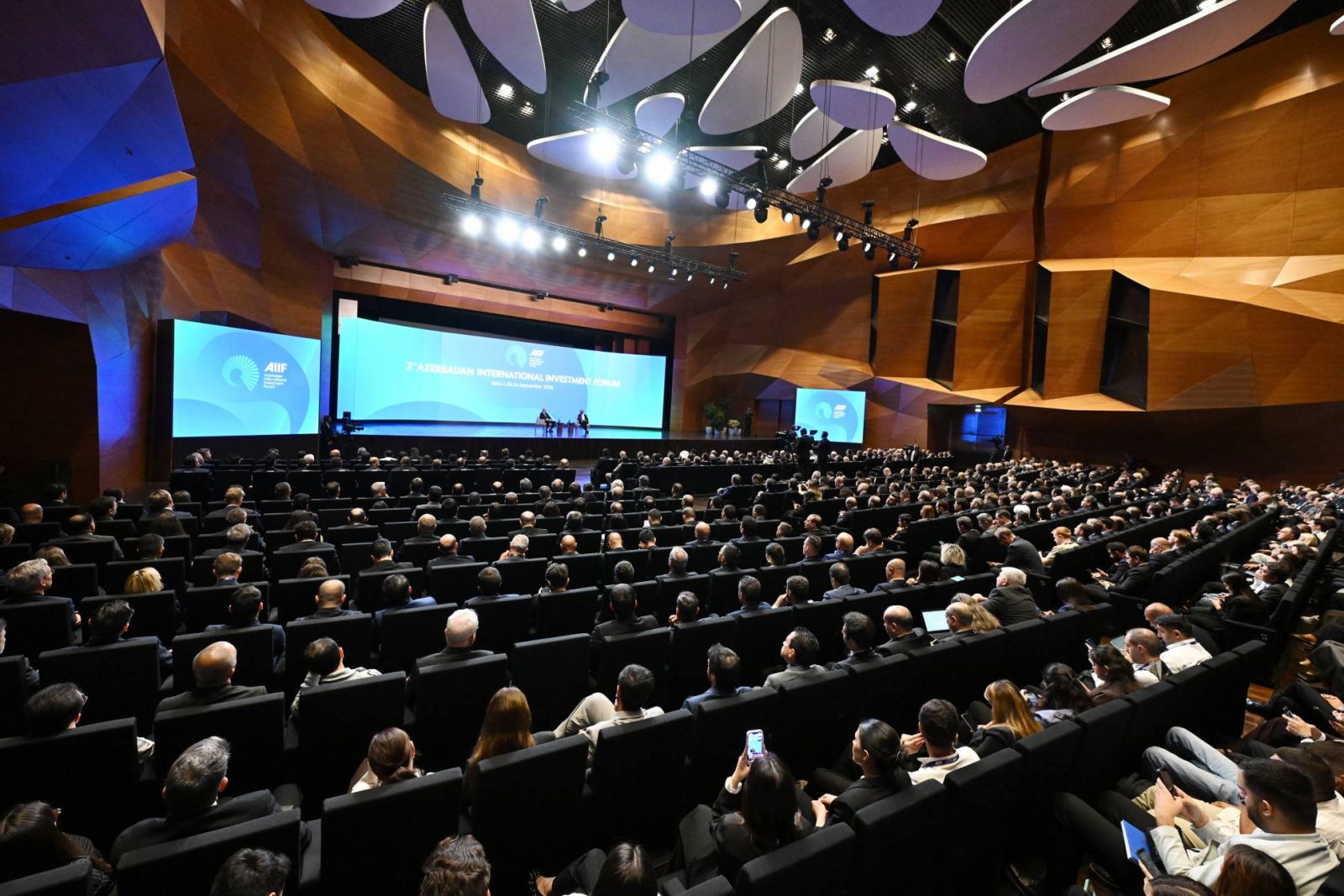
A new phase is beginning in the global economy. Supply chains are changing, energy markets are evolving, and digital technologies are becoming one of the key drivers of economic development. In such an environment, what matters to investors is not only where they invest their capital, but also how stable, accessible and promising that destination is.
In recent years, Azerbaijan has emerged as one of the key venues for international discussions on these opportunities. In this regard, the Second Azerbaijan International Investment Forum, held in Baku, is not merely an investment exhibition, but also a platform for presenting Azerbaijan’s position against the backdrop of changing global economic realities.
Renewable energy, transport and logistics, digital technologies, artificial intelligence, industry, mining, agriculture, food security and human capital — these are the key areas on the investment agenda.
The main priorities of Azerbaijan’s future economic development model also featured prominently in President Ilham Aliyev’s address at the forum.
Speaking at the forum, the head of state said that in the coming period, the potential of sectors beyond oil and gas should be utilized more extensively to ensure sustainable economic growth. He also identified renewable energy, logistics and transport, artificial intelligence and data centers, mining, agriculture and food security as promising areas for future development.
A new phase is emerging particularly in the energy sector. Azerbaijan’s goal is not merely to increase electricity generation, but to combine its renewable energy potential with transmission infrastructure and energy storage systems, thereby becoming part of a broader regional energy network.
Another priority is to transform Azerbaijan’s geographical location into an economic advantage.
According to the President, the volume of transit cargo passing through Azerbaijan is expected to reach 16 million tons in 2026. The goal is to increase the volume of freight transported along the East-West and North-South corridors to 25 million tons by 2030.
“So today we see a growing demand for transportation through Azerbaijan, whether it's East-West or North-South. We are sitting at these two important junctures. And, by the way, we are one of the very few countries that are active participants in both transportation corridors. We have seen rapid growth in transit cargo through Azerbaijan. This year it will reach 16 million tons. But our target is, by 2030, to reach 25 million tons, and maybe even more on both routes, as I said, East-West and South-North. For that, we are actively engaging with our neighbors. You mentioned Central Asia. Azerbaijan, since last November, became a full member of the Central Asian Consultative Council. This is actually an unprecedented event, because geographically we are situated in the Caucasus, but already politically and from an economic and transportation point of view, we are part of the broader Central Asian region”.
Thus, against the backdrop of a changing global economic environment, Azerbaijan is seeking to transform its geographical position, energy potential and regional connectivity into new investment opportunities. In the period ahead, the key measure of success will be the extent to which these opportunities can be translated into concrete projects, new areas of production and services, and long-term economic growth.